Authoring skills
Capture a repeatable approach as a skill, then publish it so Alto and agents apply it across your workspace.
When you find yourself explaining the same approach to a task again and again, that's a candidate for a skill. Authoring one turns that approach into something Alto and agents can apply consistently — without you reconstructing it each time.
What makes a good skill
A skill is most useful when it's focused and clearly scoped: it covers one kind of task well, and it's obvious when it should — and shouldn't — be used. The clearer a skill's "when to use" guidance, the more reliably it gets matched to the right work.
Creating a skill
Start a new skill
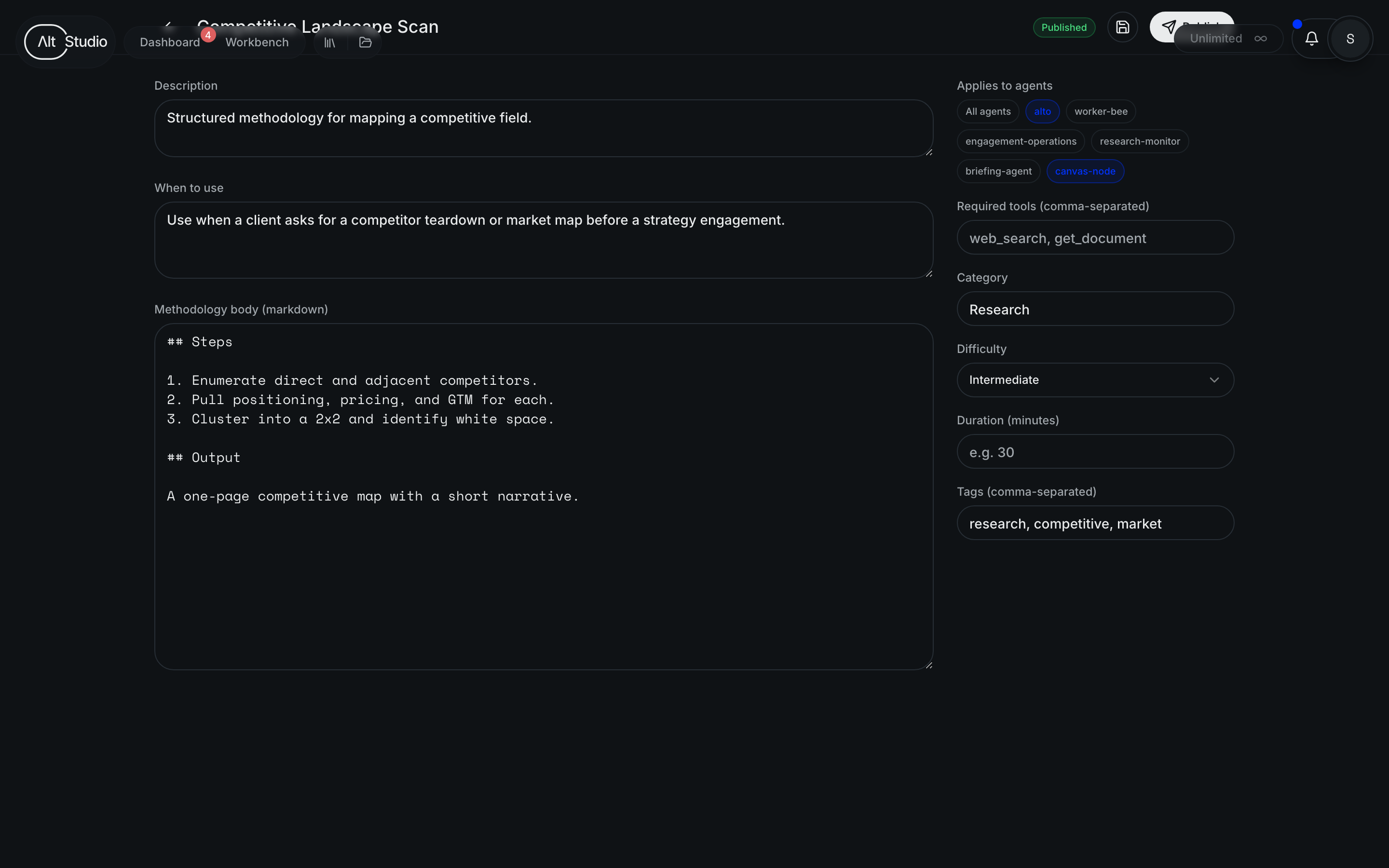
Create a new skill in your workspace's skills library and give it a title and a short description of what it does.
Describe when it applies
Add the when to use guidance, along with tags or a category. This is what lets the skill be surfaced for the right task — both when you reach for it and when an agent decides whether to apply it.
Define the approach
Capture the actual approach the skill encodes — the steps, judgment, and structure behind the task. Keep it scoped to the one job the skill is for.
Publish
Publish the skill to make it available across your workspace. Until then it stays a draft, visible to you while you refine it.
Versioning and revising
Skills follow a draft → published lifecycle, and they're versioned. As your approach improves, revise the skill and publish a new version — work that uses the skill picks up the update.
Skills capture how to approach a task; they pair with your knowledge — documents, brand, and business context — which supplies the what. Together they make output both well-structured and grounded in your material.