The knowledge graph
Beyond documents, AltStudio maintains a structured graph of the people, companies, and topics that matter — the facts about them, how they connect, and a full audit trail of where every fact came from.
Documents and transcripts are unstructured — useful, but the platform has to read them to know anything. Alongside them, AltStudio builds a knowledge graph: a structured layer of the discrete facts that matter to your work, the entities they describe, and the relationships between them. It's the difference between having your material and understanding it.
As Alto and agents work through your documents, meetings, and outputs, they extract the durable facts — who someone is, what a company does, a decision taken in a meeting — and record them as entities and relationships. Extraction is the value: these facts aren't re-derivable without re-reading the source.
What the graph captures
Entities are the things worth tracking, each with a set of structured facts:
| Entity | What it captures |
|---|---|
| Company | Organizations — industry, size, location, status, links. |
| Person | Contacts, stakeholders, team members — role, company, contact details. |
| Interaction | Meetings, calls, and emails — participants, outcomes, next steps, sentiment. |
| Topic | Research themes and subject areas the work returns to. |
Engagements also decompose into structured entities (work packages and scopes) so a body of work has a navigable shape, not just a pile of files.
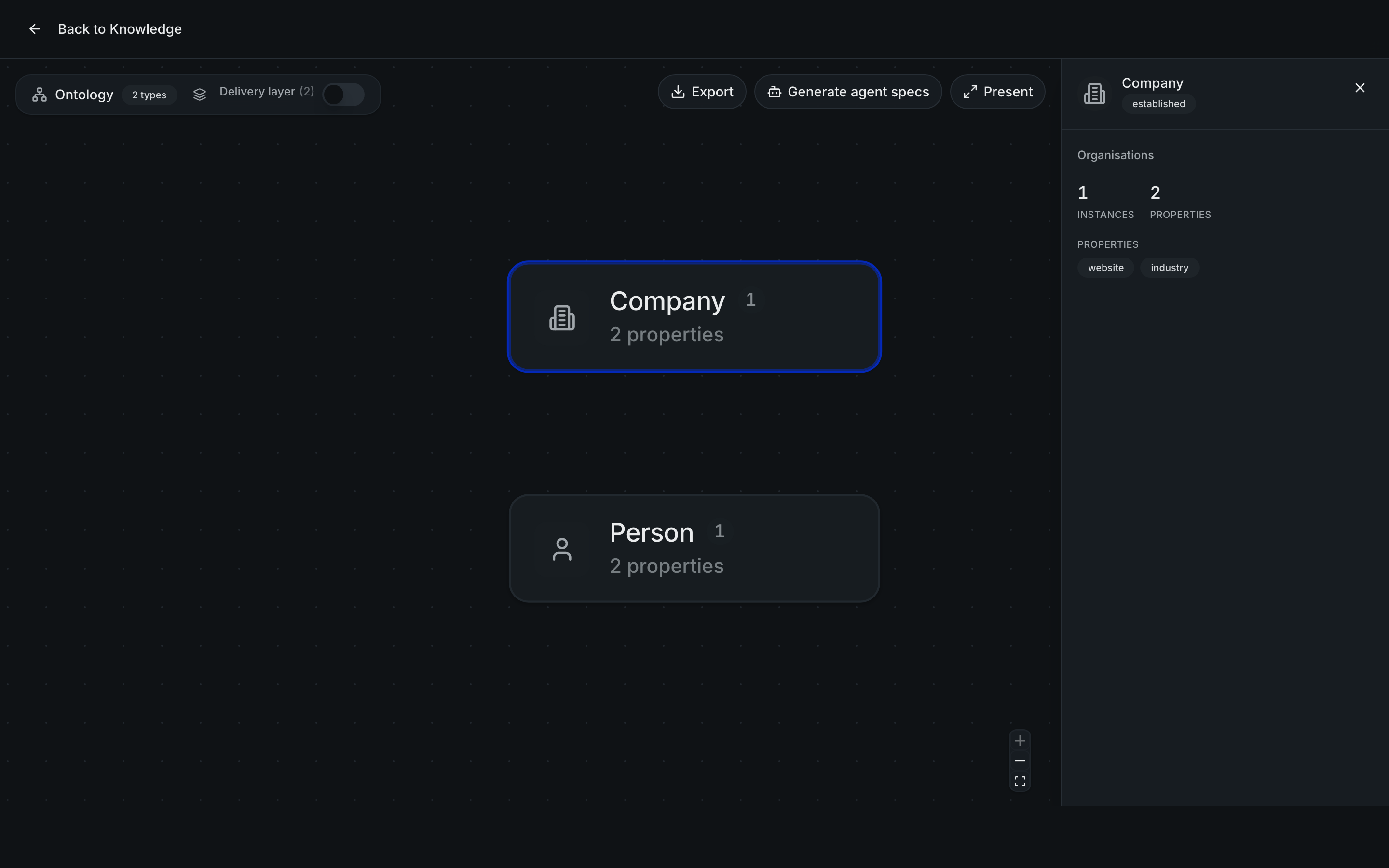
Relationships, not just documents
The real value is in the connections. Entities are linked — a person works at a company, an interaction involved certain people, an engagement covers particular topics. Those relationships form a graph that no single document expresses on its own, so the platform can answer questions across your material: who do we know at this company, what have we discussed with them, and which topics keep coming up?
Grounded in its sources
Every fact in the graph points back to where it came from — the document, transcript, canvas node, agent run, or data source it was drawn from. Nothing in the graph is unattributed: you can always trace a fact to its origin. This is the same principle behind citations — the platform shows its working.
Facts are extracted, not copied. The graph holds the discrete fact and a pointer to the source — it doesn't duplicate the underlying document. The content stays in one canonical place, so the graph never drifts out of sync with it.
Revision history & auditability
Every change to an entity is recorded — a short summary of what changed and where it came from. That history is append-only, so it forms a complete audit trail: you can see how a fact came to be, when, and on whose authority.
The source of each change is tracked and carries different weight:
- You — a fact you stated or confirmed directly. The most authoritative.
- An agent — extracted from your material by Alto or an agent.
- Enrichment — pulled from an external source rather than your own material.
That provenance means work built on the graph can be trusted and defended — you know which facts are confirmed and which are inferred, and you can always show the trail.
Why it stays coherent
Each fact lives in exactly one place and is referenced everywhere else, rather than copied. Where the platform keeps a short summary on an entity, that summary carries its own freshness markers and is checked for staleness when it's read — so you're never acting on a quietly out-of-date view. The result is a graph that stays reliable as your knowledge grows instead of accreting stale, conflicting copies.
A background memory curator reinforces this: overnight it merges duplicate entities and refreshes stale summaries, so the graph holds its accuracy over time instead of decaying between clean-ups.
Brand & business context
Give AltStudio your logos, colors, fonts, and business facts so generated documents and decks come out on-brand and on-message.
The memory curator
A background curator that keeps your knowledge graph deduplicated and its summaries fresh — so every agent reads from a cleaner, more current store, with no upkeep from you.